Paste Backfill Pumping Distance: What Engineers Need to Consider
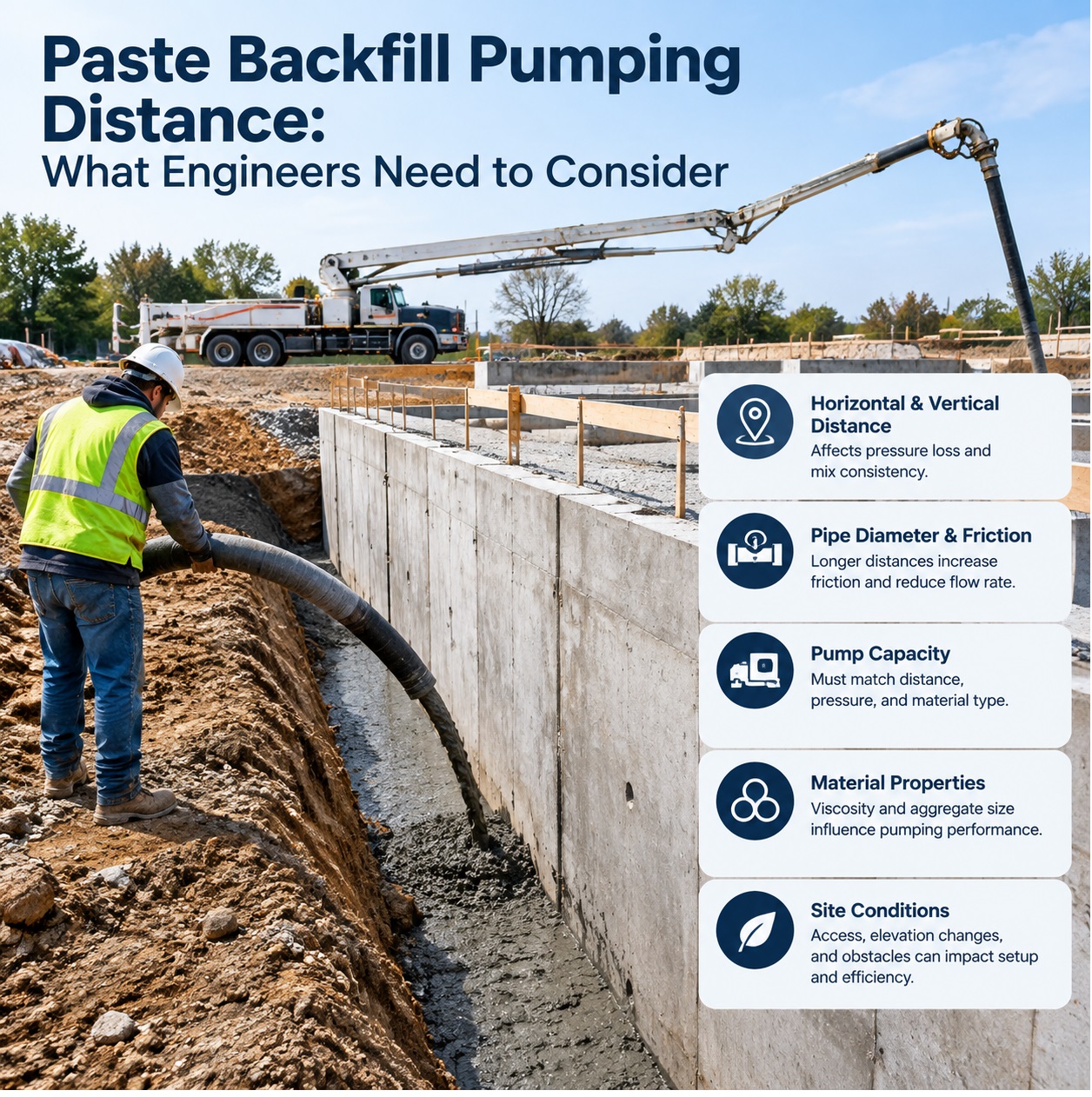 A paste backfill system rarely fails because someone picked the wrong pump curve. It fails because the distance was treated as a single number when it is really a chain of pressures, rheologies, and decisions that fight each other underground. If you are designing a paste line, the question is not “how far can we pump?” The question is “what will it cost to keep pumping that far after the orebody changes, the water chemistry shifts, and the operator pushes solids a little higher to save binder?”
That distinction matters commercially. Every extra meter of reliable pumping distance can reduce surface tailings storage, open up remote stopes, and cut trucking or ramp haulage. But every meter also adds pressure drop, wear, and risk. Marketing brochures love to quote maximum distances. Engineers have to quote the conditions behind those distances.
The first thing to kill is the idea that pipe length alone sets the limit. A 2 km horizontal line with two 90-degree bends, a vertical rise, and a partially closed valve can demand more pump pressure than a 3 km straight run. Paste is not water. It has yield stress. It can slip, plug, segregate, or restart like concrete. The pipeline is a rheological system, not a garden hose.
Start with the material. Particle size distribution, solids concentration, binder type, mixing energy, and retention time all change the rheology. A paste that flows at 76% solids may be a different animal at 80%. The yield stress that lets it stand up in a stope is the same property that makes it hard to start moving in a cold pipeline after a weekend shutdown. If your pumping distance calculation uses a single viscosity number, you are guessing. You need a rheology curve, ideally from a representative sample, not a bench test on a lab-blended tailings sample that never saw the plant cyclone.
Then look at pressure drop. For paste backfill, pressure drop is a function of flow velocity, pipe diameter, density, yield stress, and wall slip. Increase velocity to avoid settling and you increase friction. Decrease velocity to save pressure and you risk deposition. There is a narrow operating window. Engineers who widen that window with the right pipe diameter, lubrication, or additive package buy themselves distance. Engineers who ignore it buy themselves a blockage.
Pipe diameter is not a default. A 6-inch line might be cheaper to install, but it may force a higher velocity and higher pressure drop. An 8-inch line lowers velocity and pressure drop, but it costs more steel, more paste to fill, and more careful restart planning. The right diameter comes from a trade-off study, not a catalog preference. The same goes for bends. Long-radius bends, proper supports, and minimal fittings are not cosmetic. They are pressure savings and wear savings.
Pump selection follows the pressure profile. Paste backfill usually needs positive displacement pumps, often piston or rotary types, because centrifugal pumps lose efficiency fast as viscosity rises. But even within positive displacement, you have to match pressure rating, flow rate, and pulsation control. A pump that can hit 100 bar on a test stand may not survive 100 bar in a mine with abrasive tailings and variable feed. The pump package should include proper valve design, wear liners, surge control, and instrumentation that tells the operator what the line is actually doing.
Booster stations are another lever. If the total pressure exceeds a single pump’s practical limit, you can stage the system. But boosters add complexity: sequencing, control logic, maintenance access, and another place for air to enter the line. They also change the transient pressure profile. A booster that starts too fast can send a pressure spike down the line and split a pipe. A booster that starts too slow can let paste settle. The control philosophy is as important as the hardware.
Vertical runs deserve their own calculation. Gravity can help on a downhole line, but it can also create free-fall, air entrainment, and impact wear. On an upward line, you pay for every meter of lift plus friction. The mine layout, not the pump brochure, decides whether vertical distance is an asset or a tax. This is where a transient analysis earns its keep. Steady-state calculations miss the surge pressures from valve closures, pump trips, and restart sequences. Those transients often set the pipe rating, not the normal operating pressure.
Restartability is the quiet killer of long-distance paste systems. Can the line be restarted after 8 hours, 24 hours, or a week? What is the gel strength? Is there a flushing strategy? Are there drain points at the right elevations? If the answer is “we will figure it out,” the pumping distance is theoretical. A line that can pump but cannot restart is a production liability.
Wear and corrosion also scale with distance. Abrasive tailings, acidic water, and high velocity eat pipe, especially at bends and transitions. The cost per ton pumped includes replacement pipe, downtime, and labor. A longer line may need thicker pipe, wear-resistant bends, or regular rotation. That should be in the feasibility model, not discovered in year two.
So what should engineers demand before signing off on a paste backfill pumping distance? First, a representative rheology program with yield stress, viscosity, and slump at the expected solids range. Second, a pipeline simulation that includes elevation, bends, fittings, and the planned flow range. Third, a transient pressure study for startup, shutdown, and blockage scenarios. Fourth, a pump package with documented wear life and control logic. Fifth, a restart and flushing plan that operators can actually follow. Sixth, a vendor who will put their name on the guaranteed operating envelope, not just the equipment datasheet.
The commercial upside is real. When the pumping distance is engineered properly, you can backfill more stopes from a central plant, reduce surface tailings, improve ground support, and recover more ore. When it is guessed, you get blockages, pipe bursts, and a pump that runs at the edge of its curve until it doesn’t. The difference is not a bigger pump. It is a better design process. That is what engineers need to consider, and it is what separates a paste backfill system from a very expensive concrete pipeline.