What Should Importers Look for in a Solvent Ink Manufacturer?
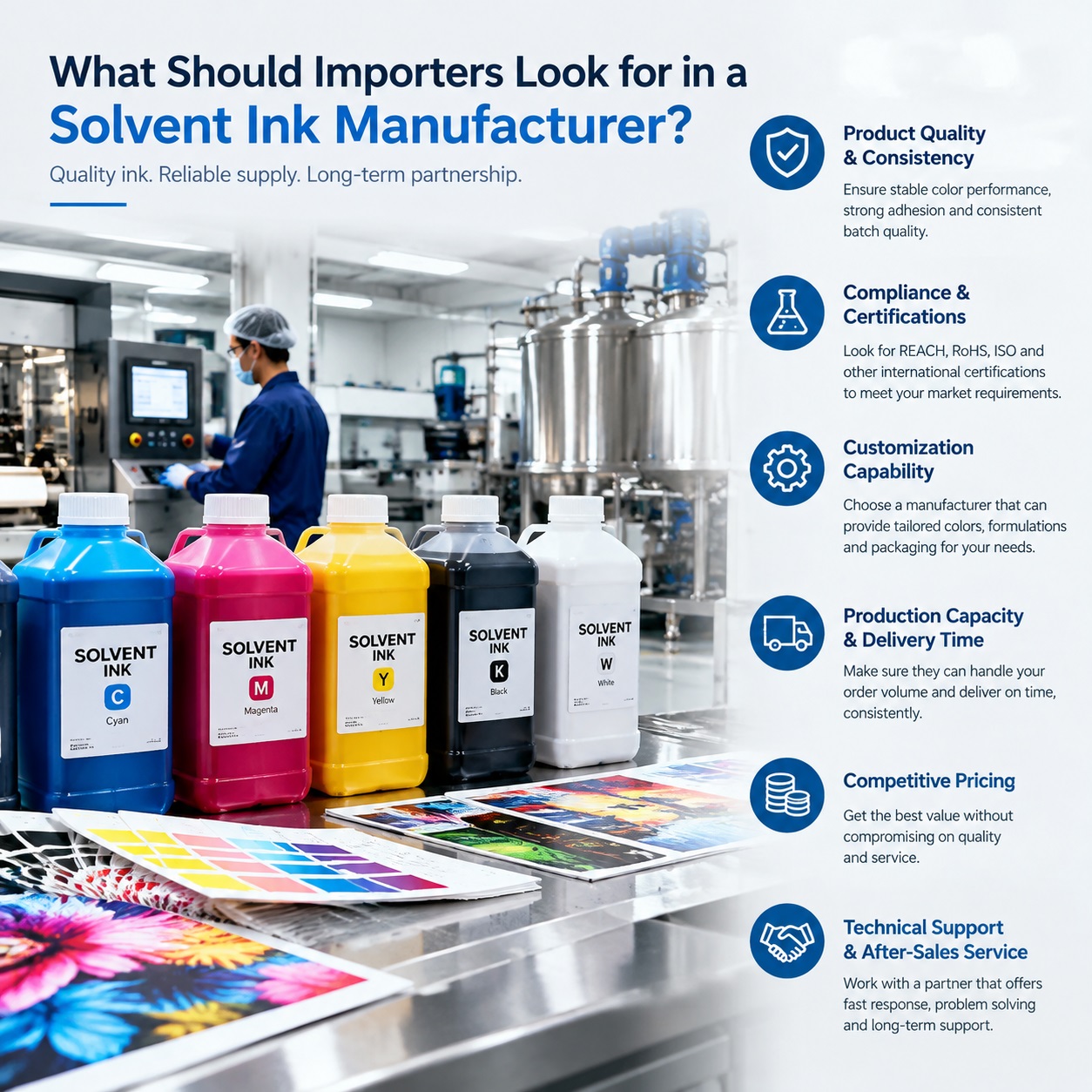 A buyer once told me he saved forty cents per liter on his first solvent ink order. Six weeks later, he replaced two printheads at roughly $1,800 apiece. That math rarely gets mentioned in the quotations, and it is exactly why choosing a solvent ink manufacturer deserves more scrutiny than most importers give it.
Solvent ink is not a generic commodity you can source on price alone. It is a chemical formulation that lives inside expensive hardware, and a bad batch can quietly destroy the machines your customers depend on. Here is what actually matters when you are vetting a manufacturer, based on what separates the reliable factories from the ones that leave importers holding the damage.
Start with printhead compatibility, not price
Every serious solvent ink is engineered around specific printhead families: Epson DX4, DX5, DX7, Ricoh Gen5, Konica Minolta, Kyocera, Xaar, and so on. Ask the manufacturer which printheads their formulations are tuned for, and listen carefully to how they answer. A real factory will talk about waveform matching, viscosity ranges, and particle size limits. A trading company will say “it works for all machines,” which is a polite way of saying they have never tested it on yours.
If you serve multiple printer brands, you need a manufacturer who can supply different ink lines rather than one universal brew. Universal usually means compromised.
Demand documentation before you demand samples
Certifications and test reports are the cheapest insurance you will ever buy. At minimum, expect a current MSDS or SDS, REACH and RoHS compliance statements if you sell into Europe, and batch-level quality control records. Some importers skip this step because the paperwork feels bureaucratic until a customs officer or a customer’s safety team asks for it.
Ask for the QC process in writing. What do they test per batch? Viscosity, density, color strength, filtration micron rating? If the answer is vague, the factory floor is probably vague too.
Quality consistency beats quality claims
Any manufacturer can produce one good batch. The question is whether batch number 47 performs like batch number 3. Inconsistent ink forces your customers to adjust profiles constantly, and eventually they stop adjusting and start switching suppliers. Ask how they handle color drift, and whether they retain samples from each production run for traceability.
This is also where you learn whether you are dealing with a manufacturer or a middleman. Factories that control their own dispersion and filtration can answer these questions in detail. Traders cannot.
Check the packaging like your reputation depends on it
Solvent ink travels across oceans, sits in hot containers, and gets stacked in warehouses. Poor packaging means leaks, and leaks mean ruined shipments, unhappy customers, and customs headaches. Look for double-walled drums or bottles with induction seals, proper hazardous goods labeling, and UN-certified packaging for transport.
Ask about shelf life and storage conditions, then ask what happens if your shipment sits in a port for two extra weeks. A manufacturer who understands export realities will have answers. One who only sells domestically will not.
Samples tell you more than brochures
Never commit to a container order without running samples on your own machines or your customers’ machines. Request a sample from a specific batch, not a “special” sample pulled from the lab. Test it across the full range: color gamut, drying time, adhesion on your typical substrates, and long-run stability.
Pay attention to how the manufacturer supports the sample process. Do they ask about your printheads, your substrates, your environmental conditions? A supplier who asks questions before quoting is a supplier who understands formulation. One who just ships a liter and wishes you luck is gambling with your money.
Watch the communication before the sale
Response time during the inquiry stage is a preview of response time during a crisis. If a technical question takes four days to answer before you have paid, imagine how fast a quality complaint gets resolved after. You want a manufacturer with English-speaking technical staff or a reliable channel partner who can translate formulation issues accurately.
Also ask who your contact will be after the order ships. Factories that hand you off to a generic sales inbox after payment tend to disappear when problems arise.
Look at the factory, literally
If the order size justifies it, visit the facility or request a video audit. You are looking for mixing equipment, filtration systems, filling lines, and a functioning QC lab. A warehouse full of unlabeled drums is not a factory. If a visit is not possible, ask for photos of the production line and recent batch records. Reluctance here is its own answer.
Stability matters more than a low quote
A solvent ink manufacturer that has been operating for years through different market cycles is worth a premium over a newcomer with a rock-bottom price. You are not just buying liters of ink. You are buying continuity of supply, formulation consistency, and someone who will still be there when your customer’s printhead warranty is on the line.
The cheapest ink in the world is worthless if it costs you a customer. The right manufacturer is a partner in your margins, your reputation, and your sleep. Vet accordingly.